_画板-111.png)
When to Add Active Ingredients to Your Acne Patch Formula: The Formulation Decision That Shapes Your Entire Line
_画板-1-1-300x300.png)
Alps Medical
15 Years of Acne Patch Factory Manufacturing and Wholesale
Table of Contents
You have your brand positioning. You have your target retail channel. Now the factory asks the question that will define your product’s entire trajectory: “Do you want a plain hydrocolloid patch, or would you like to add active ingredients?”
This is not a simple add-on decision. The answer determines your unit cost, your regulatory pathway, your claim language, your pricing architecture, and which retail channels you can enter. A plain hydrocolloid patch and an active-infused patch may look identical in the pouch, but they are different products with different business requirements.
This article maps the formulation decision that every private label acne patch buyer faces early in the planning process—and provides the framework to choose the format that fits your brand, your channel, and your cost model.
Why the Formulation Decision Matters Before You Sample
Many buyers treat ingredient selection as a sampling-stage refinement. They request a plain hydrocolloid sample, evaluate the adhesion and thickness, and then ask the supplier “can we add salicylic acid?” at the formulation discussion stage.
This sequence creates two problems:
- Regulatory reclassification. Adding salicylic acid, tea tree oil, niacinamide, or other active ingredients can shift your product from cosmetic to OTC drug territory in the US, or trigger different documentation requirements in the EU. A product designed around plain hydrocolloid may not survive the reformulation.
- Cost architecture shift. Active ingredients add per-unit cost. If you built your margin model on plain hydrocolloid pricing, adding actives without recalculating can erode profitability at scale.
- Stability testing requirements. Active ingredients can degrade over time. Patches with added actives typically require stability data that plain hydrocolloid patches do not need.
- Shelf life implications. The active ingredient’s stability affects the stated shelf life. A plain hydrocolloid patch may carry a 24-month shelf life, while an active-infused version may be limited to 12 months.
Decide your formulation approach before sampling. Evaluate samples in your intended format, not in a placeholder format that you plan to change later.
The Three Formulation Approaches
Private label acne patches fall into three formulation categories. Each has distinct cost, regulatory, and positioning implications.
1. Plain Hydrocolloid
The patch uses hydrocolloid as the functional material only. No active ingredients are added. The mechanism is passive absorption: the hydrocolloid draws fluid from surfaced blemishes through osmosis.
| Factor | Plain Hydrocolloid |
|---|---|
| Unit cost | Lowest of the three options |
| Regulatory path (US) | Cosmetic (MoCRA-compliant) |
| Regulatory path (EU) | Cosmetic (CPNP notification) |
| Stability testing | Typically not required for basic claims |
| Typical shelf life | 18-24 months |
| Claim language flexibility | Limited to passive absorption descriptions |
| Best fit | Mass market retail, pharmacy, DTC price-focused, first-time brand launches |
Plain hydrocolloid is the format that most private label launches begin with. It offers the lowest barrier to entry, the simplest regulatory path, and the most flexible claim language.
2. Active-Infused Hydrocolloid
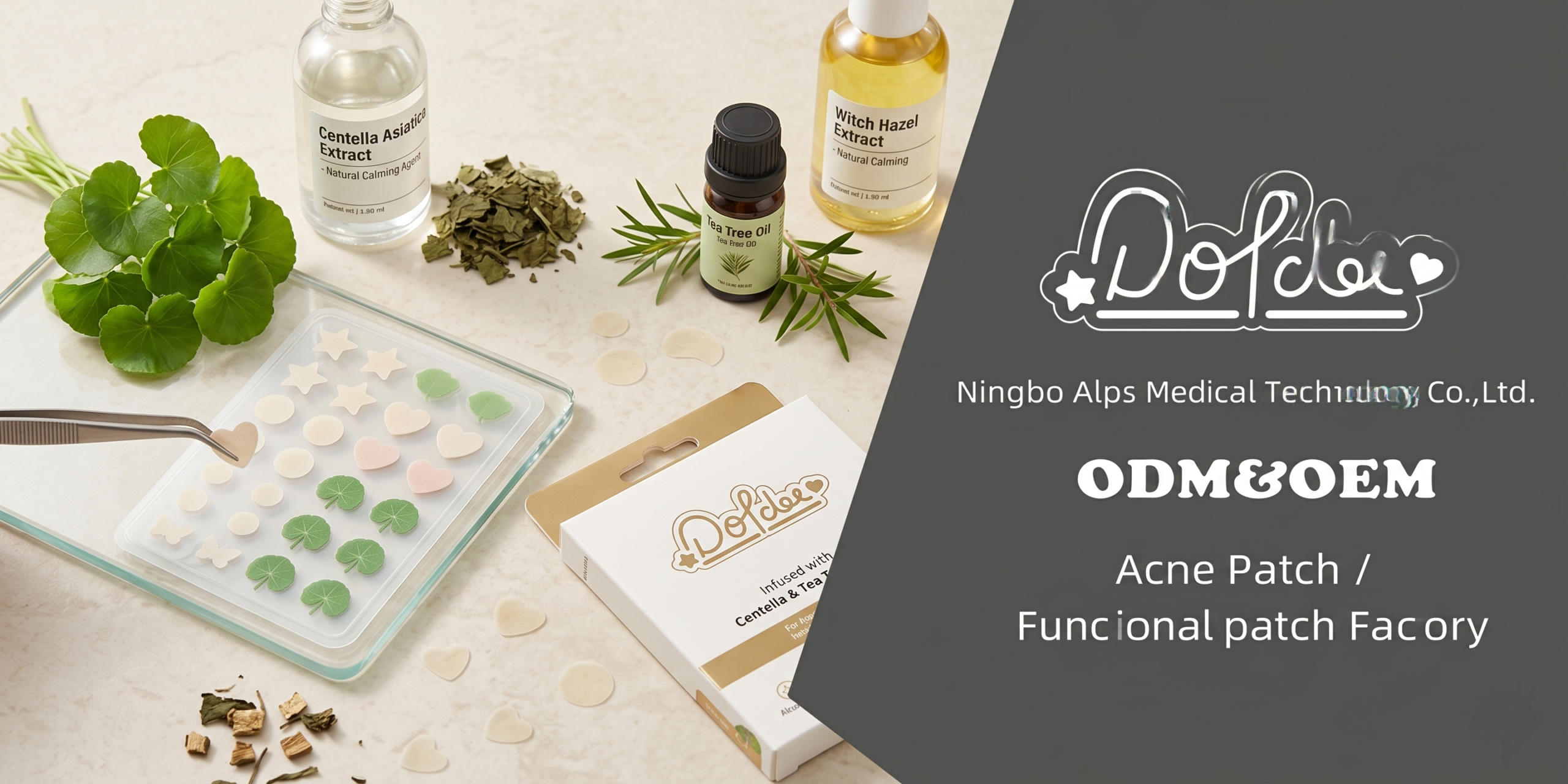
The hydrocolloid base is infused with active ingredients that diffuse into the blemish area. Common additions include salicylic acid (pore-clearing), tea tree oil (antimicrobial positioning), niacinamide (inflammation-calming), hyaluronic acid (skin soothing), or centella asiatica (redness-reduction).
The mechanism remains passive—ingredient delivery occurs through diffusion from the hydrocolloid matrix into the skin surface.
| Factor | Active-Infused Hydrocolloid |
|---|---|
| Unit cost | Medium—ingredients add $0.01-$0.04 per unit depending on inclusion |
| Regulatory path (US) | Depends on active type and concentration. Salicylic acid at OTC monograph levels triggers drug labeling. |
| Regulatory path (EU) | Cosmetic, but ingredient must be approved for cosmetic use at stated concentration |
| Stability testing | Recommended—actives can degrade |
| Typical shelf life | 12-18 months (ingredient-dependent) |
| Claim language flexibility | Ingredient-specific positioning possible but must stay claim-safe |
| Best fit | Premium positioning, specialty retail, treatment-focused DTC, ingredient-forward brands |
Active-infused hydrocolloid occupies the middle ground. It offers differentiation through ingredient positioning without the manufacturing complexity of microneedle delivery.
3. Microneedle (Microdart) Delivery
The patch contains an array of dissolvable micro-needles that penetrate the stratum corneum and deliver active ingredients into deeper skin layers. This mechanism is fundamentally different from passive absorption.
Microneedle patches typically use hyaluronic acid, niacinamide, or other actives formulated into the needle matrix. The delivery mechanism allows deeper ingredient penetration than surface diffusion.
| Factor | Microneedle (Microdart) |
|---|---|
| Unit cost | Highest of the three options—$0.05-$0.12+ per unit |
| Regulatory path (US) | Cosmetic typically, but claim review needed for any treatment positioning |
| Regulatory path (EU) | Cosmetic, but delivery mechanism may trigger additional review |
| Stability testing | Required—the needle matrix and ingredient integrity must be verified |
| Typical shelf life | 12 months (delivery mechanism-dependent) |
| Best fit | Premium price tier, specialty beauty, anti-aging + acne crossover, clinical-positioned brands |
Microneedle patches carry the highest unit cost and the highest manufacturing complexity. They serve brands seeking premium positioning with deeper delivery claims.
Decision Framework: Which Format Fits Your Business
Use this framework to select your formulation approach before approaching suppliers:
Channel-First Decision
Your target channel constrains your formulation options:
- Mass market retail and pharmacy typically perform best with plain hydrocolloid. The cost structure supports mainstream pricing, and the regulatory path is simplest.
- Specialty beauty (Sephora, Ulta, Credo) often expects active-infused or microneedle differentiation. Ingredient-forward positioning is expected, but clean ingredient standards apply.
- Amazon and DTC e-commerce offer the most flexibility. You can pursue any format if your listing and packaging support the positioning.
- Pharmacy and drug channel may require OTC monograph compliance if using salicylic acid at active levels. Verify requirements before formulation.
Margin-First Decision
Build your unit economics before choosing formulation:
- Plain hydrocolloid unit cost typically ranges $0.08-$0.15 at private label MOQs
- Active-infused adds $0.01-$0.04 per unit depending on ingredient
- Microneedle adds $0.05-$0.12 per unit
If your pricing architecture requires a $12.99-$16.99 retail price point, plain hydrocolloid offers the cleanest margin. Active inflection becomes viable at $16.99-$19.99. Microneedle typically requires $19.99+ retail to maintain healthy margins.
Claim-First Decision
Your intended marketing claims constrain your formulation:
- If you plan to claim “acne treatment,” ingredient addition may be necessary—but this triggers regulatory review
- If you market on ingredient differentiation (niacinamide, tea tree oil, hyaluronic acid), the active-infused format supports it naturally
- If you position as “gentle” or “sensitive skin,” plain hydrocolloid is the straightforward path
- If you claim “deep delivery” or “penetrates pores,” microneedle is the mechanism that supports it
Timeline-First Decision
Formulation affects your time-to-market:
- Plain hydrocolloid with stock packaging: 15-25 days sample, 20-30 days production
- Active-infused with custom formulation: 20-30 days sample, 25-40 days production (ingredient compatibility testing adds time)
- Microneedle custom: 25-40 days sample, 30-45 days production
Regulatory filing requirements may extend timelines further. Build buffer into your launch calendar.
Common Formulation Mistakes
Starting with plain hydrocolloid and adding actives later. This can require reformulation testing, new artwork for ingredient claims, and regulatory reclassification. Decide early.
Choosing active ingredients without verifying supplier capability. Not all factories can produce active-infused patches with stable ingredient integration. Verify their formulation track record before building the specification.
Underestimating stability requirements. Active ingredients degrade. Patches with salicylic acid or tea tree oil may require accelerated stability testing that adds 2-4 weeks to development.
Selecting microneedle for cost-sensitive channels. The unit economics rarely support mass market retail pricing. If your target channel demands $14.99 or lower retail, microneedle may not fit.
Ignoring ingredient concentration limits. Salicylic acid above 0.5% triggers OTC drug labeling in the US. Tea tree oil has sensitizer thresholds in the EU. Verify your ingredient levels against market regulations.
The Simple Test Before You Proceed
Ask yourself three questions:
- Can I sell this at my target retail price with my target margin in this format? If no, change the format, not the price expectation.
- Does my target consumer expect this level of ingredient intervention? Mass market buyers may prefer simple. Specialty buyers may expect advanced.
- Can I support my claims with this formulation? If you want to claim “infused with niacinamide,” the format must actually contain it at stable levels.
If all three answers align, you have your formulation approach. If any answer creates friction, revisit the format decision before sampling.
Frequently Asked Questions
Can I add active ingredients to a plain hydrocolloid patch later in production?
Adding actives after your specification is finalized typically requires reformulation, not simple additive mixing. Ingredient stability in the hydrocolloid matrix differs from topical application. A patched formula with active integration requires compatibility testing. Plan for this upfront.
What active ingredients are most common in private label acne patches?
Salicylic acid (pore-clearing), tea tree oil (antimicrobial), niacinamide (inflammation-calming), hyaluronic acid (hydration), and centella asiatica (redness-reduction) are most common. Each adds cost and carries regulatory considerations that should be verified for your target market.
Do active-infused patches cost significantly more than plain hydrocolloid?
Active ingredients typically add $0.01-$0.04 per unit, depending on the ingredient, its concentration, and the integration method. At a 50,000-unit order, this adds $500-$2,000 to the total production cost—a modest increase against a potentially significant positioning advantage.
Does adding actives change my regulatory requirements?
Yes. In the US, salicylic acid at OTC monograph levels (0.5%-2%) triggers OTC drug labeling with Drug Facts panel requirements. In the EU, ingredient inclusion must be verified against the cosmetic ingredient database. The regulatory path changes with the formulation. Verify requirements before finalizing your specification.
Can I use microneedle format for mass market retail?
The unit cost typically makes microneedle impractical for mass market retail pricing ($14.99 or lower). The format is better suited for premium DTC, specialty beauty, or clinical-positioned channels that support $19.99+ retail pricing.