_画板-111.png)
Why Retail Buyers Pass on Private Label Acne Patch Pitches
_画板-1-1-300x300.png)
Alps Medical
15 Years of Acne Patch Factory Manufacturing and Wholesale
Table of Contents
Acne patches have become a category retail buyers want in their planograms. High impulse purchase, reasonable margin, strong repeat rate, and a growing Gen Z and millennial customer base that treats spot treatment as routine self-care.
Private label brands have noticed. So have pharmacy chains, beauty retailers, and mass market buyers who are now fielding more pitches for acne patch lines than at any previous point in the category’s growth.
The problem is not finding buyers who want to stock acne patches. The problem is the pitches. Most private label acne patch brands show up with a sell sheet, a low wholesale price, and a belief that the category’s growth is enough to earn shelf space. It is not. Retail buyers make decisions against competing priorities, limited linear footage, and a need to explain every new SKU to their category teams. A private label acne patch pitch has to address what actually drives their decisions. Most do not.
This article covers the five criteria retail buyers actually evaluate before approving a private label acne patch line, and what brand owners need to bring to the meeting.
The Competitive Shelf Reality
Before brand owners build their retail pitch, they need to understand what retail buyers are comparing them against. In most retail environments, acne patch shelf space is not empty. It is occupied by:
- Established national brands with shelf velocity data, retailer co-op investment, and buyer relationships built over years.
- Retailer private label lines that benchmark directly against the best-selling SKUs in the category and undercut on price.
- Three to five other private label brands making similar pitches in the same buyer meeting cycle.
Private label acne patches compete on a different axis than national brands. National brands justify shelf space through consumer advertising, loyalty, and proven velocity. Private label brands justify space through margin, differentiation potential, and category growth contribution. A retail buyer who is already stocking two private label acne patch lines is not looking for a third that offers the same thing. They are looking for a reason to add a new line, or a reason to replace an existing underperforming one.
The brands that get approved are the ones that come in with a clear answer to the question every retail buyer is silently asking: what does your line do for my category that the current SKUs do not?
Documentation Retail Buyers Actually Request
Retail buyers do not expect brand owners to have the same documentation infrastructure as an established CPG company. They do expect enough to assess risk, complete their internal category forms, and feel confident presenting the line to their category management team. The documentation requests fall into a few distinct areas.
Category and Market Performance Data
If the brand has existing retail presence, even in a small chain or independent store, that data is the single most persuasive document in the pitch. Retail buyers evaluate new SKUs partly on category growth and partly on whether the specific brand has demonstrated it can move off the shelf.
Sales velocity data, even from a limited retail footprint, answers both questions. If no retail data exists yet, category-level reports from market research firms that show acne patch category growth, consumer demographics, and channel trends can substitute. The brand owner does not need to pay for a full market report. A summary of what the category data shows, presented clearly, is enough to start the conversation.
Compliance Documentation for the Target Market
Private label acne patches occupy a compliance gray zone in many markets. Standard hydrocolloid patches without active ingredient claims may be classified as cosmetics. Patches with salicylic acid or other active ingredients may fall under different regulatory requirements depending on concentration, claim language, and intended use. Retail buyers in regulated channels, particularly pharmacies and health-and-beauty retailers, will ask whether the product documentation is in order for their market.
For US sales, this typically means asking whether the supplier can support MoCRA facility registration and product listing requirements where applicable. For EU sales, it means asking whether CPNP registration and a cosmetic safety report are in place. Brands that have to go back to their supplier to produce compliance documents after the buyer has asked for them signal process immaturity. Brands that come to the meeting with a clear statement of the compliance status are ahead of most of the field.
Supplier Background and Production Capability
Retail buyers rarely visit factories. They do ask where the product is made, whether the supplier has experience with retail-channel compliance, and whether they can produce at the volume the buyer needs.
Short, direct answers to these questions are more effective than elaborate supplier profiles. Buyers who have been burned by stockouts from suppliers that were actually trading companies passing orders upstream are cautious. If the brand owner works directly with a manufacturer, that fact should be stated clearly. If the supplier has existing retail-channel clients in comparable markets, that is worth mentioning. If the supplier’s production capacity is sufficient to support a retail launch and subsequent replenishment, that should be confirmed in writing before the buyer asks.
What Retail-Ready Packaging Actually Means
Retail packaging for acne patches is not just about looking good on a shelf. Retail buyers evaluate whether the packaging will function correctly in their specific retail environment, which has requirements that online-first brands often do not anticipate.
Shelf Functionality
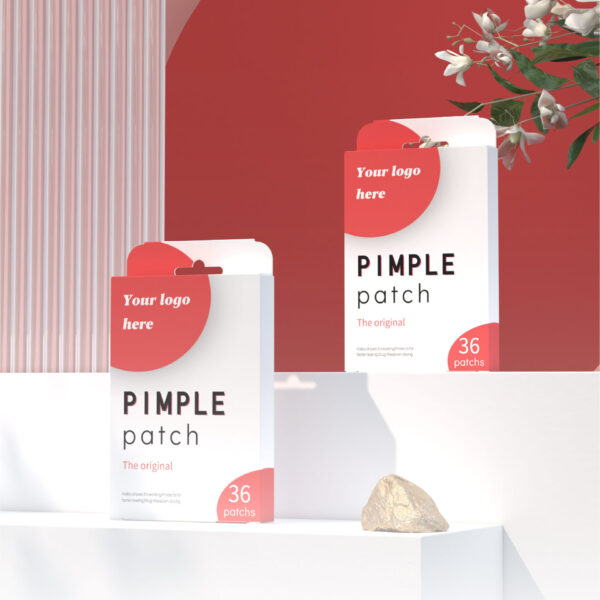
Acne patches are an impulse category. The packaging has to communicate the product’s benefit within the two to three seconds a shopper spends looking at the shelf section. For private label acne patches, this means the outer packaging should make the format and benefit immediately clear, the barcode should scan correctly, and the box or pouch should be durable enough to survive the retail handling process without damage. Brands that arrive with packaging that requires the buyer to open the box to understand what the product is have already lost a significant portion of their evaluation window.
Retail System Compatibility
Each retail chain has its own product information system requirements. This includes specific barcode formats, product description field lengths, case pack configurations, and internal SKU structures. Retail-ready packaging means the brand owner has anticipated these requirements and can supply the information in the format the buyer needs. For pharmacy channels, this also means the label content should be complete enough to pass their internal compliance review without requiring the buyer to chase missing details. Coming to the meeting with a completed retail information sheet, even a simple one, signals professionalism and reduces the buyer’s internal processing time.
The Margin Conversation
Retail buyers think in landed cost, retail price, and percentage margin. Private label brand owners who lead with wholesale price often lose the conversation before it starts. The relevant calculation for the buyer is:
- What does this product cost the retailer after landed cost?
- What retail price does the category support?
- What is the retailer’s margin at that price point?
- Will this SKU turn at that margin, or will it sit?
For acne patches, the margin conversation has become more competitive as retailer private label lines have entered the category. Retailer own-label acne patches typically benchmark against the best-selling national brand SKUs and are priced 20 to 40 percent lower, capturing margin while offering the consumer a recognizable format at a lower price. A private label brand that does not account for this competitive dynamic in their pricing narrative will struggle to get approved. The brands that handle this well come to the meeting with a clear retail price recommendation, a wholesale price that supports that retail positioning, and a genuine argument for why their line deserves margin even in a category that is being compressed from above and below.
Brands with differentiated positioning, whether through ingredient quality, format innovation, or packaging design, can support a higher retail price and therefore a healthier margin for the retailer. Brands that compete purely on cost are in a weaker position, because the retailer can achieve the same thing by expanding their own private label line.
Supply Reliability as a Buying Criterion
Retail buyers have had enough stockout experiences with private label suppliers to be cautious. A private label acne patch that performs well in its first three months on shelf and then goes out of stock for six weeks loses its retail slot permanently. Before approving a new acne patch line, retail buyers want to feel reasonably confident that the supplier can handle replenishment at the speed retail moves.
The specific concerns are:
- Does the supplier have sufficient production capacity for the buyer’s projected volume?
- What is the typical lead time from reorder to delivery at the distribution center?
- Does the supplier have a structured reorder process, or does it depend on ad hoc communication?
- Can the supplier meet the retailer’s promotional and seasonal volume spikes without quality deviation?
Brand owners who have not thought through these questions before approaching retail buyers will find the conversation difficult. The buyers who ask these questions are not trying to be difficult. They are trying to avoid the embarrassment of a planogram change that gets reversed three months later because the supplier could not deliver. The brands that answer these questions clearly, preferably in writing, before the buyer asks are the ones that get the benefit of the doubt on approval.
Moving From First Order to Full Shelf Placement
Most retail acne patch approvals start as a limited test, not a full shelf commitment. A first purchase order from a regional pharmacy chain or independent beauty retailer typically covers a single SKU, a starter display, and a conservative backup quantity. This is the right way for a private label brand to enter retail. It gives the buyer a manageable commitment, produces real sell-through data, and builds the retail relationship incrementally.
What the brand owner needs to have ready for that first order:
- The core SKU in the retail-ready packaging format the buyer approved
- A proposed display option for the initial placement
- A reorder process that is faster than the initial production lead time
- A second SKU or size option in development for the next conversation
Retail buyers who are pleased with a first order want to know two things: whether the brand has more to offer, and whether the relationship is going to be professionally managed. A brand owner who comes back for the second conversation with a line extension, a seasonal SKU, or a revised display format gives the buyer a reason to expand the placement. A brand owner who disappears for six months between orders gives the buyer time to forget why they approved the first SKU at all.
Frequently Asked Questions
What do retail buyers compare private label acne patches against?
Retail buyers typically compare new private label acne patch lines against existing national brand SKUs, other private label lines already in their planogram, and their own retailer private label acne patch options. The most successful private label pitches acknowledge this competitive landscape and present a clear differentiation argument rather than competing only on wholesale price.
What compliance documents do I need before approaching retail buyers?
The documentation requirements depend on your target market and retail channel. For US sales, this typically means confirming whether your supplier can support MoCRA facility registration and product listing where applicable. For EU sales, it typically means confirming CPNP registration status and the availability of a cosmetic safety report. For pharmacy channel retail specifically, buyers may also request patch test data and a summary of the product’s regulatory classification. Confirm which requirements apply to your specific product, claims, and target market before the buyer meeting.
How do I differentiate my private label acne patch line from retailer own-label products?
Retailer own-label lines typically benchmark against the most popular national brand SKUs and compete on price. Private label brands that differentiate through format innovation, ingredient quality, packaging design, or specific consumer audience targeting have a stronger independent positioning. The differentiation argument should be clear and specific: not just “we are different” but “we are different because our line targets X consumer, with X format, positioned at X retail price, for X reason.”
What packaging details do retail buyers actually check?
Retail buyers typically verify that the barcode scans correctly, the outer packaging clearly communicates the product benefit within seconds, the case pack configuration fits their distribution system, and the label content meets the market’s ingredient and language requirements. If your product will be sold in multiple regions, retail buyers may also check whether the packaging meets each market’s label language and regulatory requirements.
How should I handle the margin conversation with a retail buyer?
Lead with the retail price recommendation and work backward to the wholesale price, rather than leading with the wholesale price. Retail buyers evaluate margin as a function of retail price and landed cost, not as a function of wholesale price. Be prepared to explain why your line supports the retail price you are recommending, particularly if retailer own-label products are already in the category at a lower price point. Brands with genuine differentiation have a stronger argument for maintaining margin; brands competing purely on cost should be realistic about where their line sits in the category price architecture.
How do I show a retail buyer my supply is reliable before I have a track record?
If your supplier has existing retail-channel clients in comparable markets, reference that experience. Share the supplier’s production capacity information, your reorder process, and your typical lead times in writing. If you are working with dissolving microneedle pimple patch manufacturers or other specialized formats, confirm the supplier’s specific capability for your format and include that confirmation in your pitch materials. The goal is to answer the reliability question before the buyer has to ask it.
Should I start with large retail chains or smaller retailers first?
Smaller regional and independent retailers typically have shorter approval cycles, lower initial order requirements, and a greater willingness to trial new private label brands. Building a small retail track record with real sell-through data before approaching larger buyers significantly improves your position. A national pharmacy chain buyer who sees acne patch velocity data from three regional stores has a much easier case to make internally than one who sees only a product sell sheet.